


Your backyard could be growing dinner and turning heads at the same time; most home gardeners just don’t know the layout that makes it possible.
A potager garden is the French answer to that problem: a kitchen garden where vegetables, herbs, fruits, and flowers grow together in patterns designed to look good in every season, not just harvest time.
It’s not a bigger bed or a fancier fence. It’s a completely different way of thinking about a food garden’s shape, structure, and purpose.
How Do you pronounce potager garden? |
|---|
Potager garden is pronounced poh-tah-ZHAY gar-den. The “zh” sound (like in “measure”) comes from its French roots. |
What is a potager garden?
A potager garden is a traditional French kitchen garden that combines edible plants such as vegetables, herbs, and fruits with ornamental flowers in one designed space.
The term comes from potager, meaning “for the soup pot,” reflecting its original purpose of supplying fresh ingredients for daily cooking.
Unlike a standard vegetable patch arranged in plain rows, a potager relies on patterns, shapes, and structural elements like trellises or borders to remain attractive through every season.
Its purpose is twofold, supplying fresh food while also serving as an ornamental landscape feature. This blend of practicality and beauty sets the potager apart from conventional food gardens, making it both a working plot and a visual centerpiece for the home.
The history and French origins of potager gardens

This garden traces back to medieval monasteries, where monks grew food inside walled plots strictly for survival, nutrition, and medicine.
During the French Renaissance, nobles blended this utility with Italian design flair, and King Louis XIV pushed the concept further, commissioning gardener Jean-Baptiste de La Quintinie to build the famous King’s kitchen garden as a display of status.
Château de Villandry later became the clearest example of this shift, using nine square plots framed by clipped boxwood hedges to form geometric patterns symbolizing themes like love and music.
Modern gardeners now scale that same structure down to raised beds in suburban yards, using companion planting and vertical structures to keep small gardens productive and visually organized year-round.
Popular potager garden layout styles for US homes
Layout Style | Best For | Key Feature |
|---|---|---|
Square Grid | Beginners, small to medium yards | Four or more equal beds divided by straight paths |
Four-Square Design | Classic French-inspired plots | Central focal point with beds radiating outward |
Circular Beds | Small backyards or feature gardens | Concentric rings around a center point |
Keyhole Garden | Compact spaces with limited reach | Curved bed with a notch for close access to the center |
Formal French-Inspired | Larger properties, symmetrical homes | Rigid geometric shapes with clipped hedge borders |
For US homes, a square grid or four-square design works well for standard suburban lots, while keyhole and circular layouts suit smaller urban yards or patios with limited space.
Essential elements of potager garden design
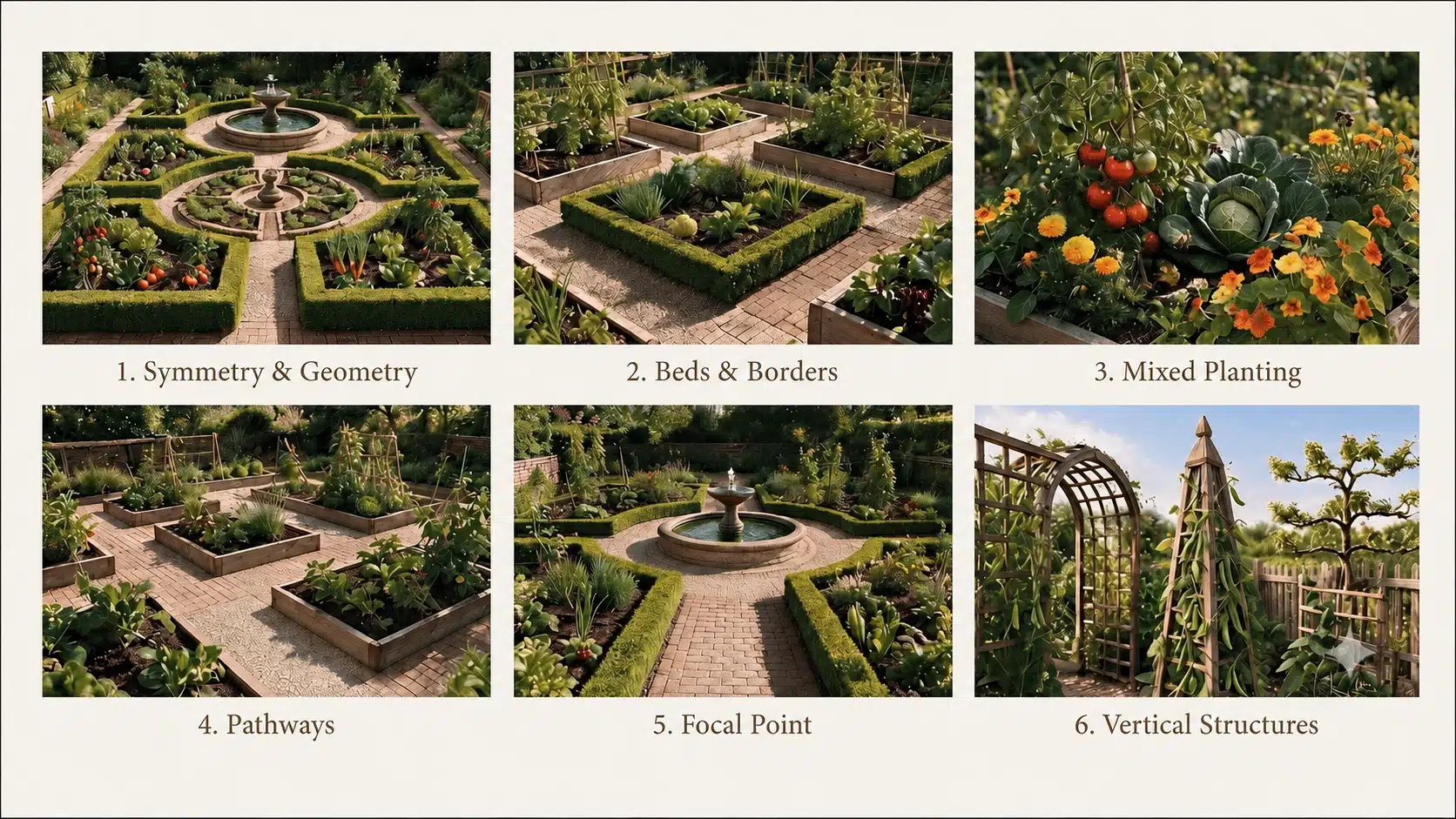
This garden combines productive planting with deliberate structure, using geometric layouts, defined beds, pathways, focal points, and mixed plantings to create an organized yet ornamental space.
These elements can be adapted to both formal French-inspired gardens and smaller home gardens.
1. Symmetry and geometry
Potager beds commonly use squares, rectangles, circles, grids, or other repeating geometric shapes to create visual order. A four-square layout, for example, divides the garden into separate beds with paths intersecting at the center.
This structured framework gives the garden a formal appearance while making individual planting areas easier to access and manage. Symmetry is common in traditional potagers, although home gardeners can adapt the geometry to their available space.
2. Beds and borders
Defined beds give each growing area a clear shape and help separate plants from pathways. Raised or in-ground beds can be framed with wood, stone, brick, metal edging, low hedges, or other materials that reinforce the garden’s structure.
Borders also help frame the overall space and can provide a finished appearance throughout the growing season. Traditional potagers often use low hedges or other permanent edges, while simpler home gardens can use less formal materials.
3. Mixed and companion planting
A potager combines vegetables, herbs, fruits, flowers, and ornamental plants instead of separation, creating variation in color, texture, height, and seasonal interest while keeping edible plants integrated into the landscape.
Companion planting can be incorporated into these mixed beds, but select plant pairings based on crop needs and growing conditions, not just common pest-control recommendations.
4. Defined pathways
Pathways separate planting beds and provide convenient access for planting, weeding, watering, and harvesting without walking on growing areas.
Gravel, brick, stone, mulch, and grass are among the materials that can work depending on the desired style. In a formal potager, pathways also reinforce the geometric pattern and help create visual lines through the garden.
5. Focal points
A fountain, sundial, birdbath, or obelisk anchors a potager garden and provides a focal point, ideally where pathways intersect or at the center of a symmetrical design, uniting the beds.
Placing a single striking feature at this junction reinforces the garden’s geometric structure while creating a visual pause within the productive space.
6. Vertical structures
Trellises, arches, and obelisks add height to a potager garden while supporting climbing crops like peas and pole beans. These structures use limited ground space efficiently, turning narrow beds into productive growing zones.
Espaliered fruit trees combine vertical growth with ornamental appeal, training branches flat against a wall or fence.
By integrating design principles, a food plot can become an attractive landscape feature. Even a few of these elements can enhance the organization and visual appeal of any home garden.
How to design your potager garden for your space?

Designing this garden for your home starts with planning the layout around your space, gardening goals, style, and growing conditions.
Define your style, needs, and capabilities: Choose formal, cottage, or French style based on time, skills, and goals.
Create a vision board: Collect inspiration from magazines, Pinterest, and nurseries, then organize recurring ideas.
List the features you want: Note desired beds, pathways, arches, sheds, and materials, including future irrigation needs.
Choose and observe the location: Pick a spot near the kitchen and observe it across seasons.
Check sunlight and wind: Track sun direction, seasonal shade, and wind exposure before placing beds or windbreaks.
Assess soil, drainage, and water access: Test soil structure, pH, and drainage, then locate a nearby water source.
Once the layout is finalized, build the beds and pathways, prepare the soil, and arrange plants by height, sunlight needs, and role in the design.
Potager garden plant list
A strong plant list keeps a potager both productive and visually balanced, mixing food crops with ornamentals suited to your climate zone.
Vegetables: beets, bell peppers, zucchini, bush beans
Herbs: thyme, chives, sage, dill
Fruits: blueberry bushes, dwarf fig trees
Flowers: calendula, sweet alyssum, snapdragons
PollinatorPlants: bee balm, yarrow, salvia
Pacific Northwest & Northern regions: leeks, Brussels sprouts, rutabaga
Southeast & Gulf Coast: eggplant, collard greens, muscadine grapes
Choose one or two plants per category rather than filling every slot, so the bed stays easy to maintain without crowding out airflow or sunlight.
Final thoughts
A well-planned potager garden turns everyday food growing into something worth walking outside for. Geometric beds, mixed plantings, and defined paths add structure and year-round appeal.
Getting the layout right from the start matters more than any single plant choice. Sunlight, soil, and spacing decisions made early save time and frustration once beds fill in.
Real gardens rarely follow a template exactly, and yours doesn’t have to either. Adapt the layout, borders, and plant mix to fit your space and daily routine.
Have you built a potager garden of your own, or are you planning your first one? Share your layout, plant picks, or questions in the comments below.
Frequently asked questions
How to plant your potager garden?
Select a sunny spot near the kitchen, prepare compost-enriched soil, sketch a four-square bed layout, add gravel or mulch paths, choose regionally suited plants, and arrange crops by height to build a productive potager garden.
How big should a beginner potager garden Be?
A 10×10-foot or 12×12-foot square grid works well for beginners, allowing a classic four-square layout with 4×4-foot raised beds and 2-foot pathways for easy access.
What Is the best location on a property for a potager garden?
The best location is close to the kitchen door, in a spot that receives 6 to 8 hours of daily sunlight, making harvesting simple and water access convenient.

